
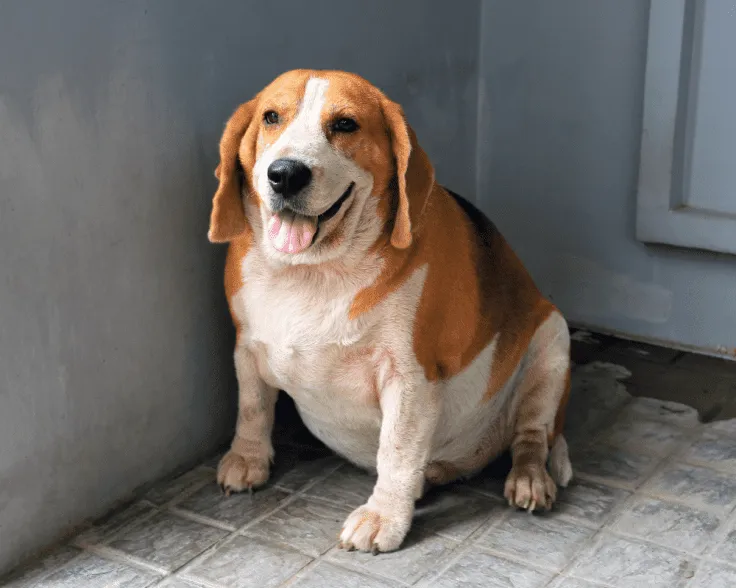
Obesity isn’t unique to humans. Did you know that 59% of dogs were classified as clinically overweight or obese? While we are very well versed in our own signs and symptoms of obesity, it can be much more of a challenge to understand our pets’ health regarding their weight.
So, how can you tell if your pet is overweight, and when is it time to call your vet?
Body Condition Score and Weight
Let’s start with one of the fundamental tools veterinarians use to evaluate the health of canines: a Body Condition Score (BCS). The BCS is a rating of your dog’s current weight compared to its ideal weight. This is determined through visual and manual assessment. You can think of a BCS as the dog equivalent of a Body Mass Index (BMI) or a similar health indicator.
BCS scales can range from 1-5 or 1-9 and typically follow the same structuring. An example is shown below, with the “ideal” range at approximately 4 to 5.

Image Source: Purina’s Body Condition System
However, just like any analytical index, a BCS isn’t without its flaws. For one, the system is subjective, outlining generalized terms of what to look for in your pet. Second, body condition scoring isn’t going to be applied the same for all dogs and can be dependent on breed, gender and age.
As a species that ranges vastly in shapes and sizes, there is no one “ideal” weight for a dog. While there are standardized ranges for each breed, a healthy size is going to be unique to your pet alone. For example, healthy greyhounds typically have visible ribs due to their conformation and haircoat, but this same statement is not true for a golden retriever.
Ask your veterinarian to help identify a healthy weight range for your pet, which is likely to correspond to a range of 4-5 on the body condition score chart. Your pet will be overweight if they are 10-20% above that number on the scale and clinically obese if that number reaches more than 20%.
Not to fear, though. Just because you can’t rely on a BCS alone doesn’t mean you can’t determine if your pet is overweight. Here are some other signs you can look out for.
Physical Appearance
As with the visual examination involved in body condition scoring, the easiest way of understanding where your dog’s weight is at is simply by looking at them. Does your dog’s waist sag? Are there fat pads at the base of its tail and top of its hips? Do its legs stick out awkwardly to the sides instead of being directly under them? These could be signs of a weight problem.
In general, your dog should have its abdomen tucked up in relation to its chest. From an overhead view, a healthy dog is one that is wider at the chest and slimmer toward the waist. If your pet has an ovular body shape from the side or over the top, you’ll know something’s up.
One of the biggest visual indicators is the ribcage. In a healthy dog, the ribs shouldn’t be very prominent, depending on the breed, but they should be very easy to feel upon touch. A telltale sign of an overweight dog is one whose ribs take excessive palpation to find.
Respiratory Issues
Another common presentation of obesity in dogs comes in the form of breathing. If you’ve noticed that your pet struggles with breathing, namely wheezing or heavy breathing, this could be a result of being overweight.
Respiratory problems can even manifest when your dog isn’t exerting effort. Checking if and how intensely your dog snores can also provide insight into its weight situation. When it comes to snoring, more is not merrier.
Difficulty with Movement
As with humans, extra weight is going to place additional pressure on joints, making movement more challenging. If your pet isn’t moving around as well as it used to, weight can be the culprit. Better indicators come in the form of more difficult movements, like running, jumping and climbing stairs.
General Behavior
As a less specific rule-of-thumb, your pet’s overall behaviors can be indicative of needing to shed some pounds. If you find that your dog has become particularly sedentary, opting for laying around as opposed to going on walks, something likely isn’t right. An absence of energy and general lethargy is never going to be reflective of positive health.
If you find your dog following any of these patterns or displaying symptoms of obesity, it’s time to schedule a visit with your vet. At the end of the day, your veterinarian will be able to give you the most thorough and definitive answer regarding your pet’s health.
To continue learning about obesity in pets, be on the lookout for our upcoming articles on diseases mimicking obesity, how to help your pet lose weight and obesity in senior pets.
Tips to Avoid Obesity in Dogs

1. Talk to your veterinarian
The best way to prevent your pet from becoming overweight is to start with gaining an awareness of their body condition. To do this, speak to your veterinary professional about your dog’s current health, find out about exercise and activity requirements and ask how many kilocalories (kcal) they should intake daily based on breed, age and lifestyle.
At the appointment, it helps to bring your pet’s food, treats, and measuring cup; taking it one step further, an accurate log of your pet’s food intake over a week or two is ideal. By having all family members write down what is fed, your vet gets an accurate picture of nutritional intake.
Record any activity your dog has engaged in during that same time period. We aren’t necessarily counting calories expended, but gauging a rough level of activity. A pug on a couch doesn’t use the same amount of energy (calories) as a border collie who chases a frisbee 2 hours a day.
2. Find the right food for your pet
When determining the best diet for your dog, keep in mind that not all breeds require the same type and amount of food. Be sure to consult your vet for various food suggestions for your dog.
The “right” foods to maintain a healthy weight also depend on your pet’s particular circumstances. Age, breed, pre-existing conditions, activity level and even environmental temperature can all affect your pet’s nutritional and caloric needs. Controlling portions is key for all pets, regardless of how “low-calorie” a food may be. In general, younger pets tend to be more active and require food higher in caloric density vs. older, more sedentary pets. A good quality protein source is important for all life stages.
Most veterinarian-approved foods meet the Association of American Feed Control Officials (AAFCO) standards for testing, nutritional content, labeling, guaranteed analysis and ingredients. It’s no small or inexpensive undertaking to create a safe, effective, palatable and nutritionally complete pet food. Some mom-and-pop shops that use colorful logos, promise “real” or “fresh” food and sell terms that are merely descriptive that can mean any number of things should be avoided unless approved by your veterinary health care professional.
For pets with specific dietary needs such as a low-fat diet for pancreatitis-prone patients, your vet may advise a calorie-controlled, prescription food to prevent obesity and manage pre-existing disease.
3. Treat them wisely
Who doesn’t love giving their pet a tasty treat in between meals? They’re always excited for treats, and you’re always delighted to offer them. However, remember that treats are not nutritionally complete and balanced. As such, they should contribute no more than 10% of overall kcal intake.
If you’re unsure what store-bought treats your pet should have, consult your vet for recommendations. You can also serve your pet fun, human-friendly options too! Healthy snacks for your dog can be apple slices, frozen yogurt “pup cups”, bananas, carrot sticks or frozen blueberries. Some owners even reserve a small portion of their daily kibble ration to be dispensed as treats. Your pet won’t know the difference, and you can effectively control intake while offering more treats throughout the day.
4. Develop healthy habits
Just as humans can develop unhealthy habits, our pets can, too. It’s imperative for your pet’s health that you help them create beneficial daily habits, including regular exercise. Develop good routines such as a long morning walk, or for senior pets, several short daily walks.
Other dogs may enjoy playing fetch, a run at the dog part or a game of hide and seek, which involves hiding a toy in the yard or house to be sought after. To mix things up, you can even try hiding so your pet can find you! For elderly pets, swimming is a particularly healthy activity that aids sore joints.
So, why should we be evaluating our pet’s weight throughout their life and ensuring they maintain an ideal weight? We witness the same physiological changes in our heavy pets that we do in overweight humans. Obesity leads to an increase in joint pain, generalized inflammation, diabetes and other metabolic issues and respiratory disease, as well as heart and kidney functional changes. It reduces life expectancy and is a financial drain on pet owners to treat obesity-related conditions. And most obviously, it compromises our pets’ ability to participate in exercise or activities with their owners, which decreases their quality of life.
At Pet Butler, we want your pet to feel their best and be their healthiest. That’s why we specialize in caring for your pet by scooping up their waste. Find a local Pet Butler near you or call 1-800-PET-BUTLER to learn how we can make your pet’s life happier, healthier and cleaner
